Choosing between an anti-hail net and an anti-bird net depends on the specific threats your crops face. An anti-hail net is designed to protect plants from hailstorms, heavy weather impact, and physical damage, while an anti-bird net is mainly used to prevent birds from eating fruits, damaging crops, and reducing harvest losses.
For fruit growers, orchards, vineyards, and vegetable farms, selecting the right crop protection net can significantly improve yield quality and reduce seasonal risks. Understanding the differences in structure, protection purpose, material performance, and application scenarios helps farmers make a more cost-effective decision.
Although both products are agricultural protection nets, their functions are different. The main difference lies in the type of threat they are designed to prevent.
| Feature | Anti Hail Net | Anti Bird Net |
|---|---|---|
| Main Purpose | Protect crops from hail impact, heavy weather, and physical damage | Prevent birds from accessing fruits and damaging crops |
| Primary Protection Target | Hailstones, heavy dew, frost, dust, and weather-related impact | Birds such as sparrows, magpies, and pigeons, as well as crop losses caused by wildlife |
| Common Applications | Orchards, vineyards, fruit farms, and agricultural fields | Orchards, vineyards, berry farms, greenhouses, farmlands, and gardens |
| Mesh Design | High-strength woven or knitted structure with optimized mesh openings for hail protection | Knitted mesh structure with diamond, hexagon, or quad mesh options for bird exclusion |
| Material Requirement | High-tensile mono yarn with durable outdoor performance | 100% virgin HDPE with UV-resistant and anti-aging additives |
An anti-hail net provides a physical barrier that absorbs and disperses the impact of falling hailstones, helping protect leaves, flowers, and fruits during severe weather conditions.
By contrast, bird netting for fruit trees creates a protective layer around crops, preventing birds from accessing ripe fruits while allowing sunlight, air circulation, and normal plant growth.
The right choice depends on whether your main concern is weather damage or wildlife interference.
Hailstorms can cause serious agricultural losses within minutes. Even a short hail event can damage fruit surfaces, break branches, and reduce marketable crop quality.
Installing an anti-hail net is recommended for farms located in regions with frequent hail risks.
Hailstones can create bruises, cracks, and surface damage on:
Apples
Pears
Grapes
Peaches
Cherries
Other high-value fruits
Anti-hail nets absorb part of the impact force and reduce direct contact between hailstones and crops.
Fruit appearance is an important factor in commercial agriculture. By reducing hail damage, farmers can improve:
Visual quality
Harvest consistency
Market acceptance
Overall crop profitability
Besides hail protection, anti-hail nets can also provide additional environmental protection by helping reduce damage from:
Heavy dew
Frost
Dust accumulation
Weather-related stress
Their porous structure allows air circulation and supports photosynthesis while maintaining crop protection.
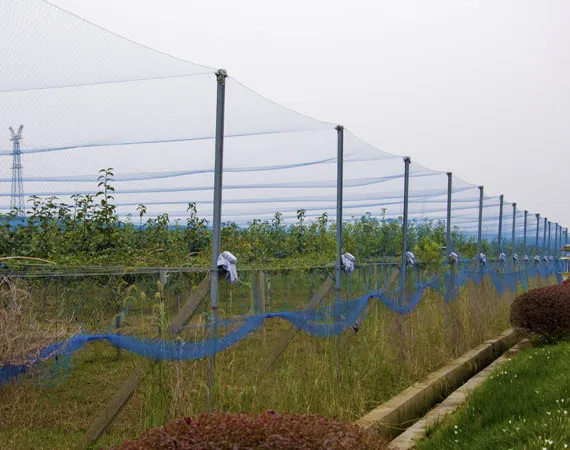
Birds can cause significant losses, especially during fruit ripening seasons. They may eat fruits directly, damage skins, or introduce contamination.
Using bird netting for fruit trees provides an effective physical barrier without harming birds or affecting crop growth.
Anti-bird nets are widely used for:
Apple orchards
Cherry farms
Blueberry plantations
Grape vineyards
Strawberry fields
Vegetable gardens
Unlike chemical repellents, bird nets offer a physical protection method that does not introduce additional substances into the growing environment.
Bird damage is often highest when fruits approach maturity. Installing protective netting before ripening helps reduce harvest losses.
High-quality anti-bird nets allow:
Air circulation
Light transmission
Pollination activity before installation
Normal plant development
This makes them suitable for long-term agricultural use.
In most cases, anti-hail nets and anti-bird nets cannot completely replace each other because they solve different agricultural problems.
Seasonal hailstorms
Severe weather conditions
Falling ice particles
Physical crop damage
Typical users include orchard owners in hail-prone regions and commercial fruit growers.
Birds eating fruits
Crop contamination
Harvest losses caused by wildlife
Typical users include fruit farms, vineyards, and gardens where bird pressure is high.
Yes. Some commercial farms use combined protection systems. For example:
Anti-hail nets provide overhead weather protection.
Anti-bird nets prevent wildlife damage.
Using both solutions can create a more complete crop protection system, especially for high-value fruit production.
Selecting the correct agricultural net requires evaluating several factors.
Start by determining the biggest threat:
Frequent hailstorms → choose anti-hail protection
Bird damage during harvest → choose anti-bird protection
Multiple risks → consider combined solutions
Different crops require different protection strategies.
For example:
Young fruit trees may need lightweight bird protection.
Mature orchards in hail regions may require stronger impact-resistant nets.
High-value fruits may benefit from multiple protection methods.
A reliable crop protection net should have:
UV resistance
High tensile strength
Stable outdoor performance
Long service life
Suitable mesh size
Material quality directly affects protection effectiveness and replacement frequency.
Professional manufacturers can provide customized solutions based on:
Climate conditions
Crop requirements
Installation methods
Farm scale
Huachang specializes in agricultural plastic textile products and provides customized crop protection solutions for global farming applications.
Jiangsu Huachang Yarns & Fabrics Co., Ltd. is located in Zhenjiang City, Jiangsu Province, with convenient transportation. The facility covers 66,000 square meters and employs 150 staff members, equipped with 10 extrusion lines, 115 Sulzer projectile looms, 48 rapier looms, and 14 Raschel knitting machines.
Huachang has obtained “SGS Audited Supplier Certification” and “ISO 9001 Quality Management System Certification.” The company specializes in producing agricultural protection products, including anti-hail nets, anti-bird nets, shade nets, anti-insect nets, anti-hail nets, weed mats, and other plastic textile products.
With continuous research and development, advanced manufacturing technology, and strict quality control systems, Huachang provides reliable solutions for customers worldwide. Its products are widely used in South America, North America, Europe, the Middle East, Southeast Asia, and Australia.
Huachang focuses on delivering stable-quality products at competitive prices and building long-term cooperation with agricultural customers. For customized crop protection solutions, you can contact the professional team through Contact Us.
Anti-hail nets and anti-bird nets serve different purposes in modern agriculture. If your farm faces hailstorms and extreme weather risks, an anti-hail net provides essential protection against physical damage. If birds are causing fruit losses, bird netting for fruit trees offers an effective and environmentally friendly solution.
The best choice depends on your location, crop type, climate conditions, and specific protection needs. For many commercial growers, combining different protection nets can provide a more complete defense system and improve long-term farming efficiency.
Choosing the right agricultural net from an experienced supplier helps protect crops, reduce losses, and achieve more stable harvest results.
Generally, anti-bird nets are not designed for hail protection. They are lightweight and mainly intended to block birds. For hail-prone areas, dedicated anti-hail nets with stronger impact resistance are recommended.
Most high-quality anti-hail nets are designed to maintain sufficient light transmission while providing physical protection. The actual effect depends on net material, mesh structure, and color.
Yes. Properly installed bird netting for fruit trees is a safe crop protection method. It helps prevent bird damage while allowing plants to receive sunlight and airflow.
The service life depends on material quality, UV stabilization, climate conditions, and installation methods. High-quality agricultural nets can provide reliable outdoor performance for multiple growing seasons.
Yes. Many commercial farms combine different protection nets to address multiple risks, such as hail, birds, and environmental stress. A customized protection system can provide better overall crop security.
 Tel/Whatsapp +86-0511-87261373
  yerm@stcco.com.cn
 English